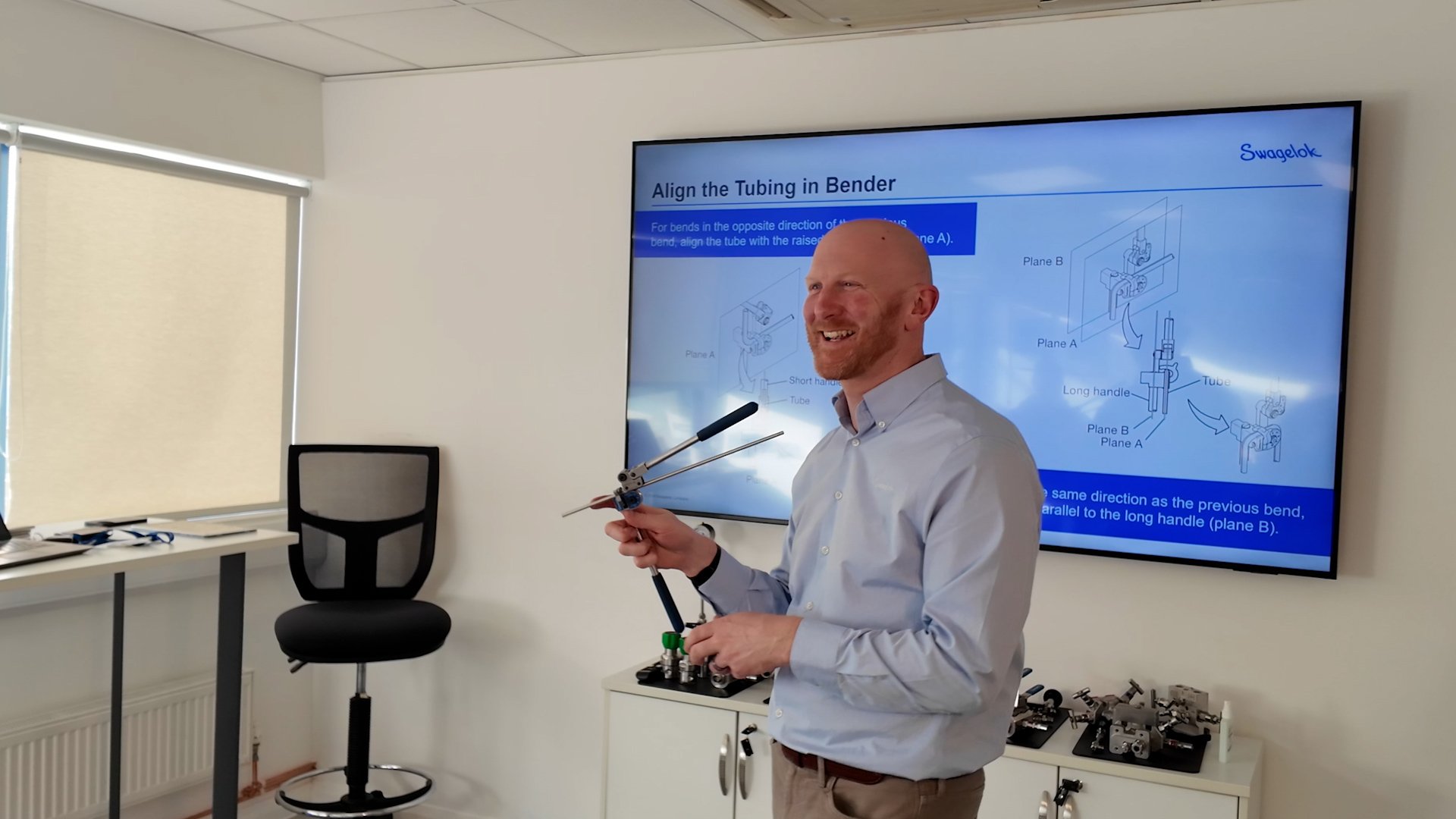

Tube Fitting Installation & Tube Installation Inspection Essentials
Training Hub >> Essentials Training Courses >> 1-day Tube Fitting Installation & Inspection
Course overview
This training bundle combines two complementary courses tube fitting installation and tube installation inspection which have been designed to develop the technical skills and inspection capabilities needed by anyone who installs, reassembles, or verifies tube fitting systems. It’s ideal for delegates responsible for ensuring fittings are installed correctly, detecting faults as they occur, and taking corrective action before leaving the site.
Course duration
1 day
Master tube fitting installation and inspection skills
This combined training course bundle offers a complete learning pathway, covering both correct tube fitting installation and the assessment of system integrity.
Delegates begin with the tube fitting installation essentials course to build practical competence, then progress to the inspection essentials course, which focuses on identifying installation issues, evaluating their severity, and applying the appropriate corrective actions.
Many roles, such as service engineers and commissioning engineers, make and break tube fitting to access other equipment, They need a skill set that allows them to assess the condition of existing fittings and tubing to safely reassemble , and/or identify rework required to reinstate a system before they leave site. This bundle provides the knowledge and skills needed to safely install / reinstall and rectify existing system.
Delegates gain the confidence to detect faults, assess risks, and apply safe, effective corrective actions in operational environments.
What you'll learn
The tube fitting installation course teaches core practices for safely assembling and reassembling tube fittings using consistent, industry-aligned methods. The inspection course then enhances delegates’ ability to critically evaluate fittings during and after installation, helping them determine whether a system requires rework before being declared safe for service.
-
A highlight of the practical training is a hands-on assessment exercise.
-
Delegates work in pairs to inspect a panel containing both correctly installed and faulty joints. Not every joint has an issue, requiring delegates to apply reasoning and justify their findings to the trainer.
-
They learn to identify which faults can be corrected, which require replacement, and which joints are safe to pass, reinforcing real-world decision-making.
This course is ideal for installers, maintenance personnel, system builders, and technicians who must ensure their work meets strict safety and quality standards and who often act as the final check before a system is commissioned.
Tube fitting training benefits for technicians and supervisors
-
Improved installation quality: Minimises leaks and failures by ensuring fittings are assembled correctly
-
Faster fault detection: Quickly identify poor installation or incorrect reassembly
-
Reduced rework and call-backs: Rectify issues on-site, saving time and costs
-
Higher system reliability: Enhanced installation and inspection skills improve long-term performance
-
Greater safety assurance: Confidently verify systems are safe before handover or start-up
-
Enhanced supervisory oversight: Provides a structured framework for assessing installation quality
Key competencies upon course completion
Delegates completing this course will be able to:
-
Safely assemble fittings: Assemble and reassemble Swagelok tube fittings consistently using proven techniques.
-
Identify common faults: Recognise issues such as under-tightening, over-tightening, damage, contamination, and incorrect component selection.
-
Assess fitting condition: Evaluate fittings during and after installation to determine if corrective action is needed.
-
Apply corrective actions: Restore system integrity before declaring a system safe for use.
-
Conduct spot checks: Perform effective inspections on installations completed by others.
-
Ensure safe handover: Understand criteria for safe handover, ensuring installations meet safety and quality standards.


.png?width=2000&height=266&name=FAQs_Website%20(3).png)